

Chan Wai-sum And Tse Yiu-kuen Financial Mathematics For Actuaries Pdf
Group of Chinese Martial arts
| | This article is missing information about What is the purpouse of Ving Tsun Athletic Association (VTAA)? . Please expand the article to include this information. Further details may exist on the talk page. (November 2021) |

 The characters are "咏春", meaning Wing Chun. | |
 Ip Man and Bruce Lee practising "双黐手", meaning "double sticky hands". | |
| Also known as | Ving Tsun, Wing Tsun, Ving Chun |
|---|---|
| Focus | Self-defense, striking, grappling, trapping |
| Country of origin | Foshan, Guangdong, China |
| Creator | Unknown; there are eight distinct lineages with different stories regarding its conception[1] |
| Famous practitioners | See Notable practitioners |
| Descendant arts | Jeet Kune Do, Arnett Sport Kung Fu, German Jujutsu[a] [2] |
| Wing Chun | |||||||||||||||||||||||||||||||||||
|---|---|---|---|---|---|---|---|---|---|---|---|---|---|---|---|---|---|---|---|---|---|---|---|---|---|---|---|---|---|---|---|---|---|---|---|
| Traditional Chinese | 詠春 | ||||||||||||||||||||||||||||||||||
| Simplified Chinese | 咏春 | ||||||||||||||||||||||||||||||||||
| Hanyu Pinyin | Yǒng Chūn | ||||||||||||||||||||||||||||||||||
| Cantonese Yale | Wihng Cheūn | ||||||||||||||||||||||||||||||||||
| Literal meaning | "beautiful springtime" | ||||||||||||||||||||||||||||||||||
| |||||||||||||||||||||||||||||||||||
Wing Chun Kuen (Chinese: 咏春拳), commonly known as Wing Chun (Chinese: 詠春), or Ving Tsun, is a concept-based traditional Southern Chinese Kung fu (wushu) style and a form of self-defense, that requires quick arm movements and strong legs to defeat opponents.[3] Softness (via relaxation) and performance of techniques in a relaxed manner is fundamental to Wing Chun.
Branches and their histories [edit]
Branches [edit]
There are at least eight distinct lineages of Wing Chun which are different, these are mostly little-known outside of the Peoples Republic of China, and each has its own history of origin. In the West, Wing Chun's history has become a mix of fact and fiction due to the impacts of early secrecy and modern marketing. Additionally, there are competing geneologies within the same branch or about the same individual teacher.[1]
| Major Wing Chun branches | |||
|---|---|---|---|
| Branch name | Background | Defining traits | Notable students of lineage |
| Yip Man[4] |
|
| Lo Man Kam, Wong Shun Leung, Bruce Lee, Victor Kan Wah Chit, Ip Chun, William Cheung and Moy Yat. |
| Yuen Kay-San[10] [11] |
| Additional emphasis on use of knives, six and a half point pole and throwing darts.[ citation needed ] | Sum Nung |
| Gu Lao[13] | This branch was taught by Leung Jan when he retired back to his native village of Gu Lao in Heshan County, Guangdong province and is typically referred to by the village name to distinguish it from the doctor's Foshan teachings. The Fung family variations found in Kulo Village have also come to be called Pin Sun (Side Body) Wing Chun.[ citation needed ] | ||
| Nanyang / Cao Dean[14] |
| Nanyang Wing Chun contains many forms and concepts. It has great amount of techniques, ranging from striking, joint-locks, throws and weapon techniques. [15] | Y.Wu (Co-Author of "Complete Wing Chun[16]" and author of The Nanyang Wing Chun Primer Vol. 1-3), S.Y Liu |
| Pan Nam[17] |
|
| |
| Pao Fa Lien[20] | Founded by Dai Dong Fung and his students Tze Gwok Leung and Tze Gwok Cheung, the branch received its name via Lao Dat Sang, who had the nickname Pao Fa Lien or "Wood Planer Lien".[ citation needed ] | Contains 28 forms. 10 forms are dedicated for bare-handed fighting, with rest meant for weapon-based fighting and/or wooden dummy practice. Includes a kwan-dao form, that is not practised in other major lineages.[21] | |
| Hung Suen[22] | According to the legend of this lineage, before the destruction of the Shaolin temple the system called Wing Chun had already been developed there. It was passed down to only a few disciples and was not documented.[22] | Hung Suen Wing Chun aims to educate its students more on Wing Chun's underlying concepts, principles and theories over individual techniques.[23] | |
| Jee Shim[24] |
| ||
| Other notable Wing Chun branches | |||||
|---|---|---|---|---|---|
| Yuen Chai Wan / Nguyen Te-Cong branch | Yuen Chai Wan - alias Nguyễn Tế-Công - Older brother of Yuen Kay-San, Yuen first learned Wing Chun Kuen under Fok Bo-Chuen and later continued his studies with Fung Siu-Ching. In 1936 he was invited to teach Wing Chun in Vietnam at the Nanhai and Shunde Expatriates Associations and moved to Hanoi, where he was known by the Vietnamese pronunciation of his name, Nguyen Te-Cong. In 1954 he relocated to Saigon (Now, Ho Chi Minh City) where he established a second school.[ citation needed ] | Tran Thuc Tien | |||
| Yiu Choi / Yiu Kai branch |
| Per Leung Ting, out of the other lineages, the Yiu Choi / Yiu Kai branch is Wing Chun Kung Fu is the closest to Yip Man branch's.[29] | Fok Chiu[30] | ||
| Jiu Wan branch |
| Ti Lung (Tam Fu-Wing) | |||
| Sum Nung |
| Sum Jee | |||
| Sum Jee | Sum Jee was Sum Nung's uncle, and the Sum Jee lineage is a major sublineage of the Sum Nung's. In addition to teaching Wing Chun, Sum Jee also integrated his many years of Hung Kuen skills into a set of exercises in which it interacts with Wing Chun , so that the apprentices can experience how Wing Chun would interact with foreign boxing techniques. | Sum Jee Wing Chun Academy upholds tradition, and everything starts with basic skills. After firmly establishing the roots, one then learns empty hand forms and progress to Chi Sao, gradually learning more advanced techniques.[34] [ promotional language ] | Sum King | ||
| Cho family branch | The Cho family of Poon Yu Village (near Shunde and Foshan) have been practitioners of southern fist systems, such as Choy Lai Fut, Hung Gar, Mok Gar, and White Crane, for many years. Cho Shun joined the King Fa Wui Goon and became an Operatic performer/actor. He became the first known disciple of Wing Chun practitioner Yik Kam.[ citation needed ] | ||||
| Fut Sao (Buddha Hand) branch | Fut Sao Wing Chun Kuen was introduced by Henry Leung "Chi-Man" (Leung Hung-Lay) in New York City back in the early 1960s. The Chinese martial art system was named after GM Leung's Teacher the renowned Chán Buddhist master Hsu Yun aka "Ghao Ji Fut Sao". Different students of Leung Chi-Man report different origins for the system, including it descended from Fung Siu Ching, Leung Bik, Chan Wah Shun, Miáo Xiǎn (Miu Sun), Xu Yun Hsu Yun, and Leung Chan Sang aka Dr Leung Jan. The Buddhist Wing Chun system can be traced back to the provinces of Kwang Chow Guangzhou, and or Canton Foshan well over 200 years ago.[ citation needed ] | Fut Sao has seven forms, and various other drills, or exercises. The forms consist of siu lum dao, chum kiu, biu gee, siu baat qua, mook yun jong, bat cham dao, and luk dim boon kwun.[ citation needed ] | James Cama | ||

Yiu Kai [edit]
The legend of Yiu Kai dates the creation of Wing Chun to the early 19th century and identifies Yim Wing-chun's father as Yim Sei (嚴四), a disciple at the Fujian Shaolin Temple who avoids persecution by fleeing with his daughter to Guangxi. Yim Wing-chun learned the Fujian Shaolin arts from her father and, from their raw material, created a new style after seeing a fight between a snake and a crane. She married Leung Bok-chao (梁博儔), a Shaolin disciple like Yim Wing-chun's father, and taught him her fighting style. The couple began teaching Wing Chun's fighting style to others after moving to Guangdong Province in 1815, settling in the city of Zhaoqing.[ citation needed ]
Redboat Opera Company [edit]
Another account is that Wing Chun was developed by people associated with the Red Boat Opera Company, a group of traveling Cantonese opera singers who toured China in the late 1800s and early 1900s who formed a popular uprising against the Qing Dynasty.[35] [36] [ better source needed ]
Red Boat troupes had been an important platform for Wing Chun to build on in Guangdong, and some of the most famous Red Boat Performers such as Leung Lan-kui, Leung Yee-tei, and Wong Wah-bo were all grand masters of Guangdong Wing Chun.[35] [ page needed ]
Nearly all extant lineages of Wing Chun, except the Pao Fa Lien and Hek Ki Boen branches, claim to descend from the members of the mid-19th-century Red Boat Opera Company. All Wing Chun descends from six Opera Boat members who were taught by Leung Bok-chao from 1845 to 1855: Yik Kam, Hung Gan-biu, Leung Yee-tai, Wong Wa-bo, Dai Fa Min Kam and Law Man-kung. Leung Yee-tai used a pole to steer the Red Opera Boat away from rocks and shoals, and was chosen by Shaolin master Jee Shim to learn the six-and-a-half point pole. Through Jee Shim, the six-and-a-half point pole was added to the Wing Chun system. Leung Yee-tai and Wong Wa-bo taught Leung Jan, whose students included his son, Leung Bik; "Wooden Man" Wah and Chan Wah-shun, from whom the Ip Man, Yiu Kai and Pan Nam lineages descend.
"Dai Fa Min" Kam, who played the role of the martial painted face, is the ancestor of the Way Yan lineage. The Yuen Kay Shan and Pan Nam branches descend from Wong Wah-bo and "Dai Fa Min" Kam. Hung Gun Biu passed the art to his son-in-law, Yin Lee-chung, and the Wang family.
In the Red Boat Opera Company the virtuous female was played by Yik Kam, better known as Ching-Deng Kam because of the role he played. Cho Shun, who played the Little Martial role, was a student of Yik Kam. By passing the art on to his son, Cho Dak-sang, Cho Shun established the Wing Chun lineage of the Cho family from the village of Panyu.[37] [38]
Tiandihui connection [edit]
Leung Jan was associated with Tiandihui via one of his teachers, Leung Yee-tai. Leung Jan had re-arranged the routine of Wing Chun based on the concept of harmony between heaven and earth - which the Tiandhui society was named after. There are only three basic routines in Wing Chun - "Shen Qiao", "Biao Zhi" and "Small Thoughts"; their respective action features correspond to heaven, earth and people. The mastery of the three basic routines becomes Tiandiren and the "Wooden Stake Method"; also known as the "108-style Wooden Stake Method".[39] [ additional citation(s) needed ]
Wing Chun in present [edit]
The Ving Tsun Athletic Association was founded in 1967 by Yip Man and seven of his senior students at the time.[40] The first public demonstration of the Wing Chun fighting system according to Yip Man took place in Hong Kong in an official exhibition fight in the winter of 1969 at what was then the Baptist College - now the Hong Kong Baptist University. Leung Ting, a student of Yip Man, invited his master and some well-known representatives of the martial arts scene of the time to the college and conducted the exhibition fights in front of the specialist audience.[41] [42]
Organizational structure in the past [edit]
In the past in ancient China, Wing Chun, like all other martial arts or craft guilds, was traditionally passed on in a familiar character, from master to student. The master, who had personal responsibility for the entire training of the student (apprentice), was addressed as Sifu (master). The lessons often took place against payment in the master's house, a personal bond between the master or his family and the student (apprentice), with certain mutual obligations, was the rule. The first public martial arts schools were established in Hong Kong. Since then, Wing Chun lessons have taken on a more modern, academic and commercial character.
However, in some schools the family system was still maintained. Lo Man-kam, a nephew of Yip Man, still teaches his students in his home in Taipei. Suitable selected long-term students are still accepted into the inner circle of the Wing Chun family by the Sifu in the traditional way through a master-student tea ceremony. This ceremony underlines the deep personal bond that has developed between master and student through the long training.
Organizational structure in modern Europe [edit]
There is no uniform umbrella organization in Europe under which Wing Chun practitioners are grouped, but rather numerous, sometimes competing and divided associations, schools and individual teachers. Most associations do not appear in the legal form of associations that have voluntarily merged to form an association, but as commercial organizations in which associated schools are integrated, which are authorized and certified by the association. Some of the associations are organized in a franchise system.
In some associations, based on the family system that was used in the past, obedience and obligations towards the master and his teacher are emphasized, although these are rarely directly related to their training students are involved.
Characteristics [edit]
General [edit]
Wing Chun favors a relatively high, narrow stance with the elbows close to the body. Within the stance, arms are generally positioned across the vitals of the centerline with hands in a vertical "wu sau" ("protecting hand" position).[43] This style positions the practitioner to make readily placed blocks and fast-moving blows to vital striking points down the center of the body; neck, chest, belly and groin. Shifting or turning within a stance is done on the heels, balls, or middle (K1 or Kidney 1 point) of the foot, depending on lineage. Some Wing Chun styles discourage the use of high kicks because this risks counter-attacks to the groin. The practice of "settling" one's opponent to brace them more effectively against the ground helps one deliver as much force as possible to them.[44] [45]
Key principles [edit]
The fundamental principles of Wing Chun are:[46] [ additional citation(s) needed ]
- Always protect your center, whether in attack or defense.
- Use the opponent's strength to turn it against him.
- Uses the principles of deflection of force for defense and the straight line for attack.
- When the bridge has been established, stay glued to the opponent's forearms ("sticky hands" principle, CHI-SAO) because information passes more quickly through contact than through the eye.
- If the opposing force is too great, give in and use your movement system to restructure.
- If the opponent retreats, follow him and keep the pressure; don't let him rebuild new plans.
- Do not use your punching force but the speed and mass of your body.
Relaxation [edit]
Softness (via relaxation) and performance of techniques in a relaxed manner, and by training the physical, mental, breathing, energy and force in a relaxed manner to develop Chi "soft wholesome force",[47] is fundamental to Wing Chun. On "softness" in Wing Chun, Ip Man during an interview said:
Wing Chun is in some sense a "soft" school of martial arts. However, if one equates that work as weak or without strength, then they are dead wrong. Chi Sau in Wing Chun is to maintain one's flexibility and softness, all the while keeping in the strength to fight back, much like the flexible nature of bamboo".[48]
Forms [edit]
Most common forms [edit]
The most common system of forms in Wing Chun consists of three empty hand forms, two weapon forms, and a wooden dummy form.[49]
Empty hand [edit]
| 小念頭 | Siu Nim Tau (Little Idea) | The first and most important form in Wing Chun, Siu Nim Tau ("The little idea for beginning"), is to be practiced throughout the practitioner's lifetime.[50] It is the foundation or "seed" of the art, on which all succeeding forms and techniques depend.[51] Fundamental rules of balance and body structure are developed here. Using a car analogy; for some branches this would provide the chassis,[52] for others this is the engine.[53] It serves as the basic alphabet of the system. Some branches view the symmetrical stance as the fundamental fighting stance; others see it as a training stance used in developing technique.[54] Although many of the movements are similar, Siu Nim Tao varies significantly between the different branches of Wing Chun. In Ip Man's Wing Chun Siu Nim Tao the first section of the form is done by training the basic power for the hand techniques by tensing and relaxing the arms.[55] In Moy Yat's Wing Chun the first section of the form is done without muscle tension and slowly in a meditative, calm, and being "in the moment".[56] In 1972, weeks before he died, Ip Man demonstrated Siu Nim Tau on film on how the form is performed.[57] |
|---|---|---|
| 尋橋 | Chum Kiu (Sinking Bridge) | The second form, Chum Kiu, focuses on coordinated movement of body mass and entry techniques to "bridge the gap" between practitioner and opponent, and move in to disrupt their structure and balance.[58] [59] Close-range attacks using the elbows and knees are also developed here. It also teaches methods of recovering position and centerline when in a compromised position where Siu Nim Tau structure has been lost. For some branches, bodyweight in striking is a central theme, either from pivoting (rotational) or stepping (translational). Likewise, for some branches, this form provides the engine to the car. For branches that use the "sinking bridge" interpretation, the form takes on more emphasis of an "uprooting" context, adding multi-dimensional movement and spiraling to the already developed engine. |
| 標指 | Biu Jee (Clear Direction) | The third form, and the last form Biu Jee, is composed of extreme short-range and extreme long-range techniques, low kicks and sweeps, and "emergency techniques" to counter-attack when structure and centerline have been seriously compromised, such as when the practitioner is seriously injured.[60] As well as pivoting and stepping developed in Chum Kiu, a third-degree of freedom involves more upper body and stretching is developed for more power. Such movements include close-range elbow strikes and finger thrusts to the throat. For some branches this is the turbo-charger of the car; for others it can be seen as a "pit stop" kit that should never come into play, recovering your "engine" when it has been lost. Still, other branches view this form as imparting deadly "killing" and maiming techniques that should never be used without good reason. A common Wing Chun saying is "Biu Jee doesn't go out the door". Some interpret this to mean the form should be kept secret; others interpret it as meaning it should never be used if you can help it. |
Weapons [edit]
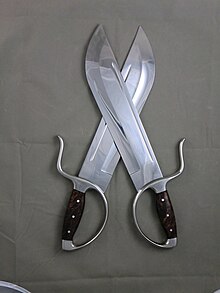
| 八斬刀 | Baat Jaam Dou (simplified Chinese: 八斩刀; traditional Chinese: 八斬刀; Cantonese Yale: Baat Jáam Dōu ; pinyin: Bā Zhǎn Dāo ; lit. 'Eight Way Chopping Knives'), also known as Yee Jee Seung Do (simplified Chinese: 二字双刀; traditional Chinese: 二字雙刀; Cantonese Yale: Yih Jih Sēung Dōu ; pinyin: èr zì shuāng dāo ; lit. 'Parallel Shape Double Knives'). | A form involving a pair of large "butterfly knives", slightly smaller than short swords (dao), as their blade is usually between 11-15 inches. Historically the knives were also referred to as Dit Ming Do ('Life-taking knives').[ citation needed ] The Baat Jaam Do form and training methods teach advanced footwork and develop additional power and strength in both stance and technique. The Baat Jaam Do also help to cultivate a fighting spirit, as the techniques are designed to slaughter the enemy. | Modern hybrid-blade-style Wing Chun butterfly swords |
|---|---|---|---|
| 六點半棍 | Luk Dim Bun Gwan (simplified Chinese: 六点半棍; traditional Chinese: 六點半棍; Cantonese Yale: Luhk Dím Bun Gwan ; pinyin: Liù Diǎn Bàn Gùn ; lit. 'Six and A Half Point Pole') | "Long Pole"— a tapered wooden pole ranging anywhere from 8 to 13 feet in length. Also referred to as "dragon pole" by some branches. For some branches that use "Six and A Half Point Pole", their 7 principles of Luk Dim Boon Gwun (Tai-uprooting, lan-to expand, dim-shock, kit-deflect, got-cut down, wan-circle, lau-flowing) are used throughout the unarmed combat as well. The name six and a half point pole comes from these 7 principles, with the last principle: Lau, or Flowing counting as half a point. |
Wooden dummy [edit]
| 木人樁 | Muk Yan Jong (Wooden Dummy) | Muk Yan Jong is performed on a wooden dummy which serves as an intermediate tool that helps the student to use Wing Chun Kuen against another human opponent. [N/A 1] Muk Yan Jong is demonstrated by using a wooden Wing Chun dummy as an opponent. There are many versions of this form which come from a variety of Wing Chun Kung Fu lineages. |
|---|
Other forms [edit]
San Sik (Chinese: 散式; Cantonese Yale: Sáan Sīk; pinyin: Sǎn Shì; 'Separate forms'), along with the other three forms, is where all of the Wing Chun techniques are derived from. They are compact in structure, and can be loosely grouped into three broad categories: (1) Focus on building body structure through basic punching, standing, turning, and stepping drills; (2) Fundamental arm cycles and changes, firmly ingraining the cardinal tools for interception and adaptation; (3) Sensitivity training and combination techniques.[61]
Empty Hand [edit]
Both the Wai Yan (Weng Chun) and Nguyễn Tế-Công branches use different curricula of empty hand forms. The Tam Yeung and Fung Sang lineages both trace their origins to Leung Jan's retirement to his native village of Gu Lao, where he taught a curriculum of San Sik.
The Siu Lim Tau of Wing Chun is one long form that includes movements that are comparative to a combination of Siu Lim Tau, Chum Kiu, and Biu Ji of other families. The other major forms of the style are: Jeui Da (Chinese: 追打; lit. 'Chase Strike'), Fa Kyun (Chinese: 花拳; lit. 'Variegated Fist'), Jin Jeung (Chinese: 箭掌; lit. 'Arrow Palm'), Jin Kyun (Chinese: 箭拳; lit. 'Arrow Fist'), Jeui Kyun (Chinese: 醉拳; lit. 'Drunken Fist'), Sap Saam Sau (Chinese: 十三手; lit. 'Thirteen Hands'), and Chi Sau Lung (simplified Chinese: 黐手拢; traditional Chinese: 黐手攏; lit. 'Sticking Hands Set').
Wooden Dummy [edit]
The Star Dummy consists of three poles that are embedded into the ground in a triangle with each pole an arms span apart. The associated form consists of kicking the poles using the various kicks found in Wing Chun: front kick, front kick with the foot pointed out using the broad area of the foot and knee rotation to outside, and sidekick.
Weapons [edit]
The Yuen Kay Shan / Sum Nung branch also historically trained to throw darts (Biu).
Sensitivity training [edit]
Wing Chun includes several sensitivity drills designed to train and obtain specific responses. Although they can be practiced or expressed in a combat form, they should not be confused with actual sparring or fighting.
Chi Sau [edit]
Chi Sau (Chinese: 黐手; Cantonese Yale: Chī Sáu ; pinyin: Chī Shǒu ; lit. 'sticking hands') is a term for the principle and drills used for the development of automatic reflexes upon contact and the idea of "sticking" to the opponent (also known as "sensitivity training"). In reality, the intention is not to "stick" to your opponent at all costs, but rather to protect your centerline while simultaneously attacking your opponent's centerline.[62] In Wing Chun, this is practiced by two practitioners maintaining contact with each other's forearms while executing techniques, thereby training each other to sense changes in body mechanics, pressure, momentum and "feel". The increased sensitivity gained from this drill helps a practitioner attack and counter an opponent's movements precisely, quickly, and with appropriate techniques. The center-line principle is a core concept in Wing Chun Kung Fu. You want to protect your own center-line while controlling your opponent's. You do this with footwork. Understanding the center-line will allow you to instinctively know where your opponent is.
According to Ip Man, "Chi Sau in Wing Chun is to maintain one's feeling of opponent's movement by staying relaxed all the while keeping in the strength to fight back, much like the flexible nature of bamboo".[48] [63]
Chi Sau additionally refers to methods of rolling hands drills (Chinese: 碌手; Cantonese Yale: Lūk Sáu ; lit. 'rolling hands'). Luk Sau participants push and "roll" their forearms against each other in a single circle while trying to remain in a relaxed form. The aim is to feel the force, test resistance, and find defensive gaps. Other branches have a version of this practice where each arm rolls in small, separate circles. Luk Sau is most notably taught within the Pan Nam branch of Wing Chun where both the larger rolling drills as well as the smaller, separate-hand circle drills are taught.
Some lineages, such as Ip Man and Jiu Wan, begin Chi Sau drills with one-armed sets called Daan Chi Sau (Chinese: 单黐手; Cantonese Yale: Dāan Chī Sáu ; lit. 'Single Sticking Hand') which help the novice student to get the feel of the exercise. In Daan Chi Sau each practitioner uses one hand from the same side as they face each other.
Chi Geuk [edit]
Chi Geuk (simplified Chinese: 黐脚; traditional Chinese: 黐腳; Cantonese Yale: Chī Geuk ; pinyin: Chī Jiǎo ; lit. 'sticking legs') is the lower-body equivalent of the upper body's Chi Sau training, aimed at developing awareness in the lower body and obtaining relaxation of the legs.
Pak Sao [edit]
Pak Sao is a blocking technique similar to a parry used in boxing. With Pak Sao, the hand comes directly out of the center of the body to slap away an attacker's strike to one's head. Effective application of Pak Sao involves creating an angle of deflection through which the opponent's blow can be slapped away with minimal effort.
An overcompensating Pak Sao may allow the attacker a free shot. This is because excessive effort creates the risk of being trapped by one's opponent if said opponent pulls the Pak Sao down and traps one's other arm with it.
In popular culture [edit]
Donnie Yen played the role of Wing Chun Grandmaster Ip Man in the 2008 movie Ip Man, and in its sequels Ip Man 2, Ip Man 3, and Ip Man 4.[64] [65] Max Zhang (Zhang Jin) who played the role of Cheung Tin Chi in Ip Man 3 starred in a spin-off and direct sequel movie called Master Z: The Ip Man Legacy.[66]
Tony Leung Chiu-wai played the role of Wing Chun Grandmaster Ip Man in the 2013 film The Grandmaster, directed by Wong Kar-wai.
Stephen Amell on the CW show Arrow has incorporated Wing Chun into his fighting style; his character practices on a Muk Yan Jong (wooden dummy).[67]
In December 2019, a new Wing Chun fighter named Leroy Smith was introduced to the fighting game Tekken 7 roster as downloadable content. When creating characters to represent real-world martial arts, the developers wanted to introduce a new fighter utilizing Wing Chun. The developers consulted Ip Man's nephew, who provided motion capture for the character. [68]
Notable practitioners [edit]
Some notable practitioners of Wing Chun are Ip Man and his sons Ip Chun and Ip Ching, the martial artist actors Bruce Lee, Donnie Yen, and Dan Inosanto, and the actor Robert Downey Jr.[69] [70]
See also [edit]
- Chinese martial arts
- Wing Chun terms
- Wushu
- List of movies featuring Wing Chun
Notes [edit]
- ^ Wing Chun techniques were added to German Jujutsu curriculum in year 2000. Prior to that German Jujutsu did not contain Wing Chun techniques.
References [edit]
- ^ a b Chu, Ritchie & Wu 2015, pp. 1–2
- ^ Braun, Christian (2004). Ju-Jutsu - Effektives Training. Das Prüfungsprogramm vom Gelb- und Orangegurt. Aachen, Germany: Meyer & Meyer Verlag. ISBN 3-89899-011-7.
- ^ Concepts, Steve Creel, Wing Chun. "About Wing Chun Kung Fu". Wing Chun Concepts . Retrieved 2018-11-26 .
- ^ a b c d Chu, Ritchie & Wu 2015, pp. 4–27
- ^ Boehler, Patrick (27 August 2014). "Chinese kung fu masters battle over inheritance of Yip Man's Wing Chun legacy". South China Morning Post (Online). South China Morning Post Publishers Ltd. Retrieved 10 September 2016.
- ^ Chu 2015, pg.27
- ^ Leung Ting, Roots and Branches of Wing Tsun, ISBN:9627284239
- ^ Peterson, David. Look Beyond the Pointing Finger: The Combat Philosophy of Wong Shun Leung. ISBN0-9579570-0-9.
- ^ Hintelmann, Jan P. Westliche Sinnfindung durch östliche Kampfkunst?. ISBN978-3-88939-774-4.
- ^ Chu, Ritchie & Wu 2015, pp. 28–44
- ^ Leung Ting, pg.238
- ^ Chu 2015, page 28
- ^ Chu, Ritchie & Wu 2015, pp. 45–52
- ^ a b c Chu, Ritchie & Wu 2015, pp. 53–68
- ^ Chu 2015, pg.60, 68
- ^ Cite error: The named reference
Chuwas invoked but never defined (see the help page). - ^ Chu, Ritchie & Wu 2015, pp. 69–77
- ^ Chu 2015, pg.77
- ^ Plum Staff. "The Open Gate to the Garden of Chinese Martial Arts". plumpub.com. Plum Publications. Retrieved 12 December 2020.
- ^ Chu, Ritchie & Wu 2015, pp. 78–82
- ^ Leung Ting, pg.344
- ^ a b Chu, Ritchie & Wu 2015, pp. 83–89
- ^ Chu 2015, pg.89
- ^ a b Chu, Ritchie & Wu 2015, pp. 90–99
- ^ Chu 2015, pg.92
- ^ Yiu Choi Wingchunpedia.org
- ^ "Archived copy". Archived from the original on February 8, 2013. Retrieved 2013-02-09 . CS1 maint: archived copy as title (link)
- ^ Sifu Sergio presents a visit to the Yiu Choi lineage of wing chun part 1
- ^ Leung Ting, pg.246
- ^ Leung Ting, pg.279
- ^ Jiu Wan 1Wing Chun Kuen
- ^ Jiu Wan 2 Archived October 8, 2007, at the Wayback Machine
- ^ sumjee.com
- ^ sumjee.com
- ^ a b Ye, Guo (4 July 2019). "Canton Kung Fu: The Culture of Guangdong Martial Arts". Sage Jurnals (Online). SAGE Publications Inc. Sage open. doi:10.1177/2158244019861459. Retrieved 11 October 2020.
- ^ "Cantonese Popular Culture and the Creation of Wing Chun's "Opera Rebels."". Chinesemartialstudies.com. Kung fu tea. Retrieved 8 October 2020.
- ^ DUHALDE, MARCELO (8 November 2019). "Cantonese performing art". South China Morning Post (Online). South China Morning Post. Retrieved 11 October 2020.
- ^ Ye, Guo (4 July 2019). "Canton Kung Fu: The Culture of Guangdong Martial Arts". Sage Jurnals (Online). SAGE Publications Inc. Sage open. doi:10.1177/2158244019861459. Retrieved 11 October 2020.
- ^ "澳門日報電子版". web.archive.org. February 11, 2018.
- ^ "詠春體育會 - Ving Tsun Athletic Assosiation". www.vingtsun.org.hk (in Chinese and English). 2019-11-27.
- ^ "詠春體育會發展簡介 - Kurzer Überblick zur Entwicklung des Ving Tsun Athletic Assosiation". vingtsun.org.hk (in Chinese). 2019-11-27.
- ^ "The Development of Ving Tsun Kung Fu in Hong Kong (1961–1970) – 香港詠春體育會發展 (1961–1970)". www.vingtsun.org.hk (in Chinese and English). 2019-11-27.
- ^ "How to Wu Sau Correctly - Technique is Everything | Sifu Och Wing Chun". Sifu Och Wing Chun. 2016-09-07. Retrieved 2017-03-08 .
- ^ "Rediscovering the Roots of Wing Chun". Kung Fu Magazine . Retrieved 2010-02-06 .
- ^ McKnight, David; Kwok Chow, Sifu Chung. "Integrative Wing Chun". Kung Fu Magazine. Archived from the original on 2013-03-14. Retrieved 2010-02-06 .
- ^ Betsy Olay (7 September 2016). "HOW TO WU SAU CORRECTLY – TECHNIQUE IS EVERYTHING". Retrieved 13 September 2019.
- ^ Roselando, Jim (2011-01-28). "One Wing Chun Kung Fu Family – W1NG : » Coaching From The Ancestors". Archived from the original on 2011-01-28. Retrieved 2019-01-19 .
- ^ a b "An Interview With Grandmaster Yip Man from 1972". My Way of Wing Chun. 2013-07-11. Retrieved 2018-02-10 .
- ^ "Wing Chun Forms".
- ^ "WING CHUN CONCEPTS: Siu Nim Tao". Wing Chun Concepts. 2017-09-23. Archived from the original on 2017-09-23. Retrieved 2017-10-24 .
- ^ Michel Boulet. "The Simple Basics of a Complex Art". the Wing Chun Archive. Retrieved 2013-02-10 .
- ^ Jim Fung (2009-02-23). "Wing Chun Stance". International wing Chun academy. Wingchun.com.au. Archived from the original on 2014-03-19. Retrieved 2013-02-10 .
- ^ "The Hidden Power of Siu Nim Tau by Tsui Sheung Tin". 2017-05-22. Archived from the original on 2017-05-22. Retrieved 2018-11-23 .
- ^ Sifu Cogar. "An Overview of Wing Chun". richhealthandwellness.com. Archived from the original on 2010-02-03. Retrieved 2007-05-04 .
- ^ Knight, Dan (March 13, 2014). "Sil Lim Tao the first form". www.kwokwingchun.com . Retrieved 2019-01-23 .
- ^ "WING CHUN CONCEPTS: Siu Nim Tao". 2017-09-23. Archived from the original on 2017-09-23. Retrieved 2019-01-23 .
- ^ Philosophadam (2012-10-21), Grandmaster Ip Man Doing Sil Nim Tao (Normal and Slow Motion Speeds) , retrieved 2019-02-12
- ^ "The Forms of Wing Chun Kuen Kung Fu | Reading Academy Wing Chun & Kali". Teamwingchun.co.uk. Archived from the original on 2012-05-01. Retrieved 2013-02-10 .
- ^ "Ving Tsun Martial Arts Studio – Training". Tstvingtsun.bc.ca. Archived from the original on 2013-06-28. Retrieved 2013-02-10 .
- ^ "City Wing Chun – Training Notes". Archived from the original on April 15, 2009.
- ^ Hill, Robert (2010). "Ch5-Wing Chun". World of Martial Arts !. Lulu Enterprises. ISBN978-0-557-01663-1.
- ^ "Chi Sau: What's Behind Sticky Hand Training". Wingchunlife.com. Retrieved 2013-02-10 .
- ^ "Wing Chun and Bruce Lee". Post Magazine. 17 February 2019. Retrieved 2019-02-17 .
- ^ "2008 Chinese Box Office records". Boxofficemojo.com. Retrieved 2013-02-10 .
- ^ "IP Man 4 Teaser Trailer Pits Donnie Yen Against Scott Adkins". Movies . Retrieved 2019-03-20 .
- ^ Shaw Theatres (December 3, 2018), "Master Z: The Ip Man Legacy Official Trailer", YouTube , retrieved 2019-01-19
- ^ "Arrow's stunt coordinator teaches us how to fight like Oliver Queen". Youtube. December 19, 2014.
- ^ "TEKKEN 7 - Dev Diary: Leroy Smith & Fahkumram". YouTube. January 27, 2020. Retrieved 2020-01-29 .
- ^ "Robert Downey Jr.: "He Was Skinny"". 16 December 2011. Archived from the original on July 10, 2016. Retrieved July 9, 2016.
- ^ "Robert Downey Jr.'s Cosmic Punishment". Archived from the original on June 30, 2016. Retrieved July 9, 2016.
Bibliography [edit]
- Chu, Robert; Ritchie, Rene; Wu, Y. (2015). The Definitive Guide to Wing Chun's History and Tradition. Tuttle Publishing. ISBN978-1-4629-1753-2.
- Leung, Ting (2000). Roots and Branches of Wing Tsun, Second edition (January 1, 2000). Leung Ting Co ,Hong Kong. ISBN962-7284-23-8.
External links [edit]
-
 Media related to Wing Chun at Wikimedia Commons
Chan Wai-sum And Tse Yiu-kuen Financial Mathematics For Actuaries Pdf
Source: https://en.wikipedia.org/wiki/Wing_Chun
Posted by: vallebechapte.blogspot.com
0 Response to "Chan Wai-sum And Tse Yiu-kuen Financial Mathematics For Actuaries Pdf"
Post a Comment