

What Draw Weight For Recurve Bow
Published February 28, 2022 in Archery Tips
Yes, you can adapt the depict weight on sure recurve bows

Compound bows are well known for their ability to have the draw weight adjusted. Most accept a 10-pound adjustment range, simply there are some that tin be adjusted from 5-70 pounds.Did you know it's possible to adjust the weight of some recurve bows?In an episode of "Backside the Riser," filmed by Shrewd Archery, which follows U.S. Olympian Brady Ellison during the 2022 Lancaster Archery Classic, Ellison talks virtually "taking three turns out of" his Hoyt recurve bow after the first twenty-four hours of competition. That action inverse the draw weight from 52 pounds to 47 pounds. (Ellison went on the win his second consecutive title at the Classic in the Men's Recurve Division.) So yes, y'all can modify the draw weight of certain recurve bows. The simply bows this will work on, even so, are those Olympic recurve and Traditional recurve bows that have ILF limbs and fittings.ILF stands for "International Limb Plumbing equipment," which is a universal limb attachment system that allows ILF limbs and risers from diverse manufacturers to be mixed and matched. Several Hoyt recurve bows employ a modified ILF connection system that uses the same hardware as ILF bows, only the hardware spacing is distinctly different than ILF. This unique limb connectedness system is the Hoyt Formula arrangement. Formula bows adjust in exactly the aforementioned manner as ILF bows.
 An ILF or Hoyt Formula riser will have dovetail pockets to capture the dovetail bushings on the limbs. And they'll besides accept limb bolts. The limb bolts on these risers are adjustable. Turning the limb bolts clockwise lowers the bolts closer to the riser and increases draw weight. Adjusting counterclockwise raises the bolts and decreases depict weight. Too, well-nigh all risers with adaptable limb bolts employ some type of locking screw to go on a limb bolt in place afterward adjustments have been made. It is very important to unlock these screws before adjusting limb bolts, and then lock them again when adjustments are complete.According to John Wert, who heads the TradTech sectionalization of Lancaster Archery Supply, which produces ILF and non-ILF recurve risers and limbs, the bolts on ILF recurve bows take a recommended best working range. Starting at a maximum height of 20mm (13/xvi of an inch) for lowest describe weight and adjusting in to a minimum height of 15mm (v/8 of an inch), for the highest draw weight. Those distances are measured from the underside of the limb bolt to the surface of the limb pocket beneath information technology.
 "This is the best range for the entire sphere of ILF bows," Wert said. "You can take some in or out farther, but then you are in a gray area that can atomic number 82 to problems. If yous know what to await for, you can adjust to as low every bit 12 mm and as high as 25 mm on some limb and riser combinations."The chief problem with turning in a limb bolt shorter than 15mm is the leading edge of the limb bolt cap can start to dig into the limb surface. Dorsum the limb commodities out more 20mm, and the dovetail limb bushing can bind in the riser hardware– or even worse, the limb could fly out from nether the bolt altogether.
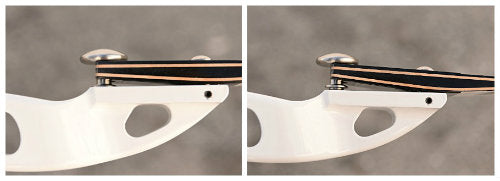 The number of turns an archer tin put in or take out of a limb within that 15-20mm frame varies, co-ordinate to Wert. Some screw patterns on the limb bolts are more ambitious than others, which would affect the full turns.It's up to each archer to effigy out how many turns the limb commodities tin withstand to stay inside that fifteen-20mm gap. Also, the corporeality of weight that tin can be added or subtracted varies from bow to bow. It'southward up to the archer to figure that out, and so he or she knows how many turns are possible, and how much weight each turn gives upwards or puts dorsum on. Simply generally, a prepare of limbs has an aligning range of 8-10% of the limb's draw weight.
 During the Lancaster Archery Archetype, Ellison was able to reduce his draw weight by about 5 pounds by taking three turns out of his Hoyt limb bolts.It'due south important to note that equal turns must be put into/ taken out of the top and bottom limbs in order to maintain the tiller. Diff turns will affect a bow's tiller measurements, which can bear upon the bow's melody and the manner the bow sits in your hand.Bow manufacturers vary on how they determine limb weights. Some, like TradTech archery, stamp their limbs with the depression end of their weight range. So a TradTech limb rated at 50 pounds would draw at a minimum of 50 pounds at 28 inches with the limb bolts backed out to 20 mm. The weight would increase from at that place as the bolts are turned in and the limbs would reach a maximum weight of approximately 54 pounds.
 Other companies, like Hoyt, utilise the middle of the range for their limb ratings, and some rate their limbs at the meridian end of the aligning range.So all of this begs the question, "Why would I change the draw weight on my recurve?"In the Shrewd video, Brady said he was having trouble property his bow still at the higher draw weight. And then he lowered it to gain more than control. Other archers might observe more command by increasing the draw weight.Another reason to adjust draw weight might exist to get an arrow to melody better. If the tune is close at a prepare draw weight, changing the weight just a lilliputian could be all that'due south needed to get perfect flying.

Source: https://lancasterarchery.com/blogs/archery-tips/yes-you-can-adjust-the-draw-weight-on-certain-recurve-bows
Posted by: vallebechapte.blogspot.com
0 Response to "What Draw Weight For Recurve Bow"
Post a Comment