

Can Drawing Dadum Place On The Center Line Of The Part For Drafting
Alphabet of Lines
What is the chief image, which we are using in all our projects, designs, drawings?
It is a line!
In Graphics Communication practise there is the whole collection of different lines, which are used for drawing purposes.
The alphabet of lines is a set of standard line types established by the American National Standards Institute (ANSI) for technical drawing. The alphabet of lines and the approximate dimensions used to create different line types, are referred to as linestyles when used with CAD.
The standard line types used in technical drawings are

Eye lines are used:
- to represent symmetry,
- to represent paths of motion,
- to marking the centers of circles and the axes of symmetrical parts, such as cylinders and bolts.
Break lines are used to show where an object is broken to save drawing space or reveal interior features.
Suspension lines come in two forms:
- a freehand thick line, and
- a long, ruled sparse line with zigzags.
Dimension and extension lines are used to indicate the sizes of features on a drawing.
Department lines (hatching) are used in section views to represent surfaces of an object cut by a cutting plane.
Phantom lines are used to stand for a movable feature in its different positions.
Stitch lines - to indicate a sewing or stitching process.
Visible lines are used to stand for features that can be seen in the electric current view.
Hidden lines, every bit you already know, are used to represent features that cannot exist seen in the current view.
Cutting plane lines are used in department drawings to bear witness the locations of cut planes.
There are besides lines used in some particular cases:
Chain lines - to indicate additional treatment for a surface.
Symmetry lines - as an axis of symmetry of a particular view.
While preparing drawings you must follow the rules established for the line technique.
Each line should have i of the two thicknesses, thick or thin, and the ratio of the thicknesses must exist not less than 2:one. In many textbooks (especially, of the US authors) you will come up across the thicknesses of lines: 0.iii mm and 0.6 mm. In general cases it is good plenty in applied work.
The alphabet of lines assigns specific thickness to each line and information technology cannot be changed arbitrarily.
In cases where other than shown types of lines are used for special drawings (for example, electric drawings, pipeline diagrams, or edifice drawings) the conventions adopted must be conspicuously indicated by reference to specific standards or by notes on the drawings.
For all views of i piece or assembly to the aforementioned calibration, the thickness of the lines should exist the same. Medium and extra-thick lines should exist used only in special cases.
The minimum space between parallel lines should never be less than twice the thickness of the heaviest line. Information technology is recommended that these spaces exist 0.vii mm or greater.
In end views of round features the point of intersection of ii centre lines should be shown by two intersecting curt dashes, except for very small circles, equally shown:
Intermission Line are used to shorten the view of long uniform or tapered sections, or when just a fractional view is necessary, and are used on both detail and assembly drawings.
The thin line with freehand zig-zags is recommended for long breaks and may be used for solid details or for assemblies containing open up infinite.
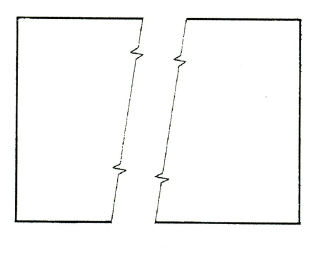
Thick freehand lines are used for brusque breaks

and the jagged line for wood parts.
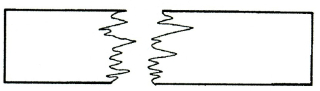
The special thick intermission lines shown for cylindrical and tubular parts are useful when an end view is not shown, just otherwise the thick freehand break line is adequate.

Note that all these interruption lines were designed for preparing drawings in the old-fashioned style by using a typhoon board. Sometimes engineers and designers still piece of work on drawings with pencils and rulers. However, modern 3D CAD software, which prevails in our days, tin offer other line types for the break lines in the computer-based drawings.
Dimensioning practise
Once the shape of a part is defined with an orthographic drawing (i.eastward., in projections), the size information is added in the class of dimensions.
Dimension elements
Dimensioning a drawing also identifies the tolerance (or accuracy) required for each dimension.
- Dimension — the numerical value that defines the size, shape, location, surface texture, or geometric characteristic of a feature.
- Basic dimension — a numerical value defining the theoretically exact size, location, or orientation relative to a coordinate organization. Basic dimensions are enclosed in a rectangular box & have no tolerance.
- Reference dimension — a numerical value enclosed in parentheses, provided for information only.
- Dimension line — a sparse, solid line that shows the extent and direction of a dimension.
- Arrows — symbols at the ends of dimension lines showing the limits of the dimension, leaders, and cutting plane lines.
- Extension line — a thin, solid line perpendicular to a dimension line, indicating which feature is associated with the dimension.
- Visible gap — in that location should be a visible gap of ane mm betwixt the characteristic's corners and the end of the extension line.
- Leader line — a thin, solid line with arrow drawn under an angle & indicating the characteristic with which a dimension or notation is associated.
- Limits of size — the largest acceptable size and the minimum acceptable size of a feature.
- Plus and minus dimension — the allowable positive and negative variance from the specified dimension.
- Diameter symbol — a symbol indicating that the dimension shows the diameter of a circle. The symbol used is the Greek alphabetic character phi Ø.
- Radius symbol — a symbol indicating that the dimension shows the radius of a circumvolve. The radius symbol used is the upper-case letter letter R.
- Tolerance — the amount that a detail dimension may vary.
Bones concepts and principles
- The unit for dimensioning should exist in accordance with the policy of the user. On a drawing for use in American industry for manufacturing, all dimensions are in inches, unless otherwise stated.
- Most countries outside of the The states, including Canada, use the metric system of measure out, or the international system of units (SI), which is based on the meter.
The common metric unit of measure out on applied science drawings is the millimeter, abbreviated every bit mm.
Sometimes, you volition have to place dimensions in 2 units simultaneously!
Dimensions should be placed in the near descriptive view of the characteristic.
If the view is overcrowded with different dimensions, two and more carve up drawings with the same view tin can be produced.
Dimension text placement
Text of the dimensions tin be placed in unlike ways:
- dimension inside the extension lines, with arrows inside or outside; and
- dimension outside the extension lines, with arrows again inside or outside.
Where infinite is limited extension lines may be drawn at an angle:
Extension lines should not cross dimension lines, and they should avert crossing other extension lines whenever possible. When extension lines cantankerous object lines or other extension lines, they should non be cleaved. When extension lines cross or are shut to arrowheads, they should be broken for the arrowhead.
Arrowless dimensioning
To avoid having many dimensions extending abroad from the part, arrowless dimensioning may exist used.
- the "goose egg" lines stand for the vertical and horizontal datum lines,
- each of the dimensions shown without arrowheads indicates the distance from the zippo line.
- There shall never be more than one cypher line in each direction.
- Arrowless dimensioning is used for locational dimensions for a serial of features such as holes and slots.
All dimensions and annotation text must exist oriented to read from the lesser of the cartoon. This is called unidirectional dimensioning.
The aligned method (where text is placed parallel to the dimension line) may exist seen on older drawings or on architectural drawings but is not approved by the current ANSI standard.
Grouping dimensions
In standard practice, dimensions are grouped on a cartoon for uniform appearance.
Avoid using object lines every bit extension lines for a dimension.
Dimensions must be kept exterior the boundaries of views, wherever practical.
Dimensions tin be placed in series and parallel.
- When a series of dimensions is practical on a point-to-indicate basis, it is referred to as concatenation dimensioning .
The first dimension in a raw should exist stuck to a base line.
Disadvantage of this system: it may result in an undesirable aggregating of tolerances betwixt individual features.
- When several dimensions offset from a common reference betoken or line, the method is referred to as mutual-betoken, or parallel, dimensioning .
The reference line may exist an extension of the outline of the origin, a base line, or a system line.
The base surface is the external surface of the part, which must be machined commencement.
Dimensions can be placed in parallel or in serial, but in all cases, they should be related to the base (datum) surface.
Stagger dimensions
The general exercise is to stagger the dimension text on several parallel dimensions.
Size dimension
The dimensions tin be classified by types of size:
- Horizontal — the left-to-right altitude relative to the cartoon sheet. Hither the width is the just horizontal size dimension.
- Vertical — the up and down distance relative to the cartoon sheet. Here the height and the depth are both vertical dimensions, even though they are in 2 different directions on the role.
- Diameter—the full distance across a circle, measured through the eye.
- Radius—the altitude from the center of an arc to whatever indicate on the arc. Radius is commonly used on arcs less than half circles.
Location and orientation dimensions
The dimensions can be classified by type of location or orientation:
- Horizontal position – locates the position of the feature in horizontal direction with respect to a base;
- Vertical position – locates the position of the feature in vertical direction with respect to a base;
- Angle – gives the angle betwixt the horizontal plane and the sloping surface.
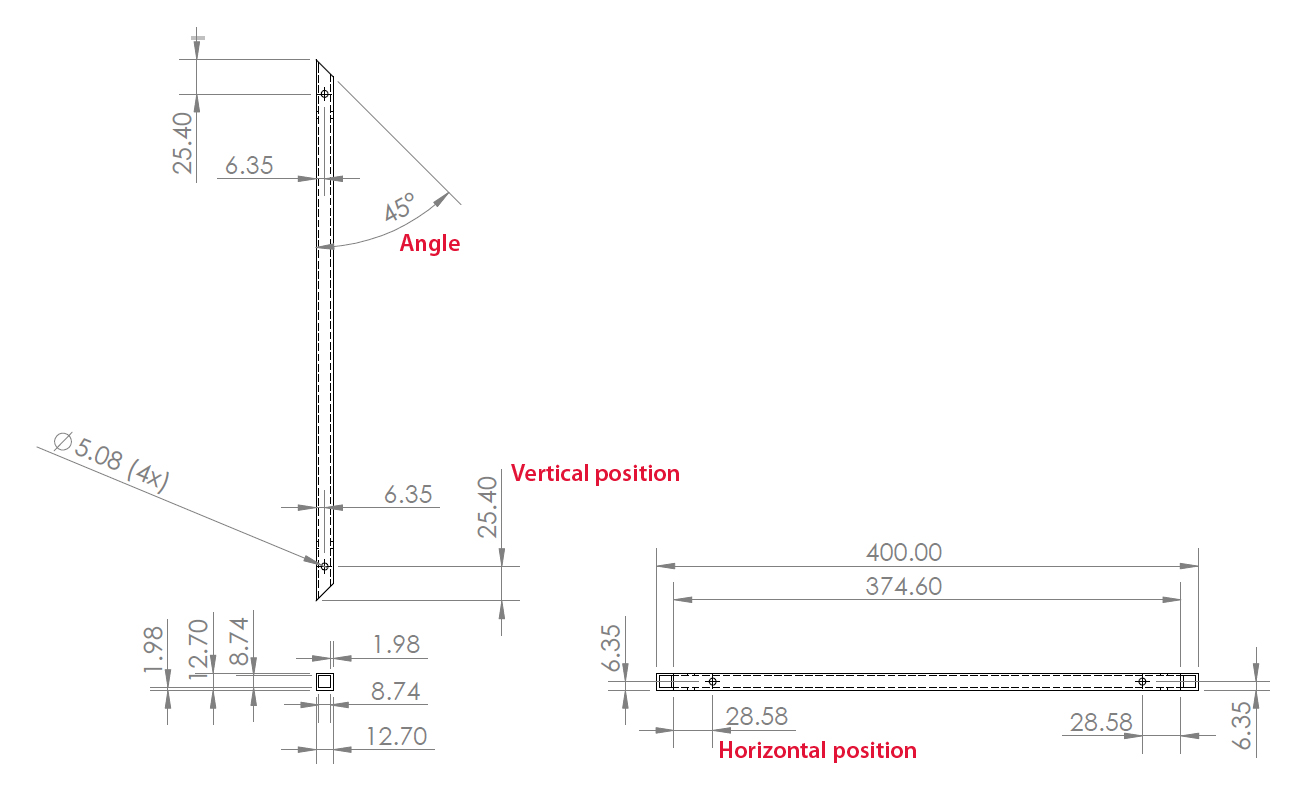
Angular units
- Angular dimensions are shown either in decimal degrees or in degrees, minutes, and seconds.
- Where but minutes and seconds are specified, the number of minutes or seconds are preceded by the 00.

It is as well good to accept an isometric view of the part on its drawing. Not mandatory but preferable for complex parts.
No dimensions should be shown on isometric view. Calibration must exist shown if information technology differs from the general 1.
Detail dimensioning (How to dimension various features)
- Holes are typically dimensioned in a view which best describes the shape of the hole. Diameters must be dimensioned with the diameter symbol preceding the numerical value. When holes are dimensioned with a leader line, the line must be radial.
A radial lin eastward is one that passes through the center of a circumvolve or arc if extended.
- Symbols may be used for spotface, counterbore, and countersunk holes. These symbols ever precede the diameter symbol.
The depth symbol may be used to bespeak the depth of a hole. The depth symbol is placed preceding the numerical value.
- When the depth of a blind pigsty is specified, information technology refers to the depth of the full diameter of the hole.
- Chamfers are dimensioned by providing either an angle and a linear dimension or by providing 2 linear dimensions.
Chamfers of 450 may be specified in a annotation.
- Slotted holes may be dimensioned any of several ways depending on which is most appropriate for the awarding.
- The slope of a line or flat surface tin exist specified:
(a) as a ratio combined with the slope symbol; (b) by the bending; (c) past the dimensions showing the departure in the heights of two points from the base line and the distance between them.
- Dimensioning chords, arcs and angles
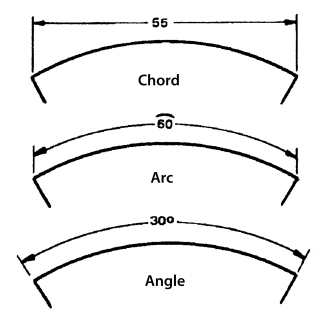
- Keyseats and keyways, which are fastening devices, are dimensioned in a detail mode, because they present some unusual problems.
The tiptop of the keyseat itself is not dimensioned considering, once the superlative of the shaft is cut away, there is no characteristic left to mensurate.
Also the dimensions are unilateral:
- for the keyseat, the dimension is a minimum;
- for the keyway, the dimension is a maximum.
This is to ensure an interference once the key is inserted between the parts.

Dimensioning repetitive features
- Repetitive features and dimensions may be specified past the utilise of an "Ten" in conjunction with the numeral to betoken the " number of times " or " places " they are required. A total space is left between the "X" and the feature dimension.
An "X" is sometimes used to indicate " By " between coordinate dimensions specified in annotation form. A half space is left in this case between the "10" and the dimensions.
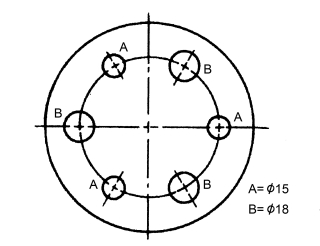
To avert repeating the same dimension or to avoid long leader lines, nosotros may use reference letters in conjunction with an explanatory tabular array or annotation.
- Identification of similar sized holes
- Dimensioning gears
A gear is a toothed-wheel mechanical device used to transit power and movement between machine parts. Typically a shaft is used to both employ and receive power from the gears.
When two gears of different sizes mesh, the larger is called the gear and the smaller is the pinion.
Usually, gear drawings include a tabular array of data, chosen cut information, for manufacturing. A item drawing of a gear would too include other dimensions not found in the table (root diameter, diameter diameter, keyway dimensions).
Alternatively, gears and splines may be shown with a solid line representing the bones outline of the part, and a lighter line representing the root of the teeth.
The pitch line may be added using the standard centre line. This is the aforementioned convention as used for screw threads.

Source: https://www.mcgill.ca/engineeringdesign/engineering-design-process/basics-graphics-communication/principles-dimensioning
Posted by: vallebechapte.blogspot.com
0 Response to "Can Drawing Dadum Place On The Center Line Of The Part For Drafting"
Post a Comment